How to Organize Kitchen Cabinets: A Zone-by-Zone Plan
Put things where you use them. A simple layout for upper cabinets, base cabinets and corners that works in any size kitchen.
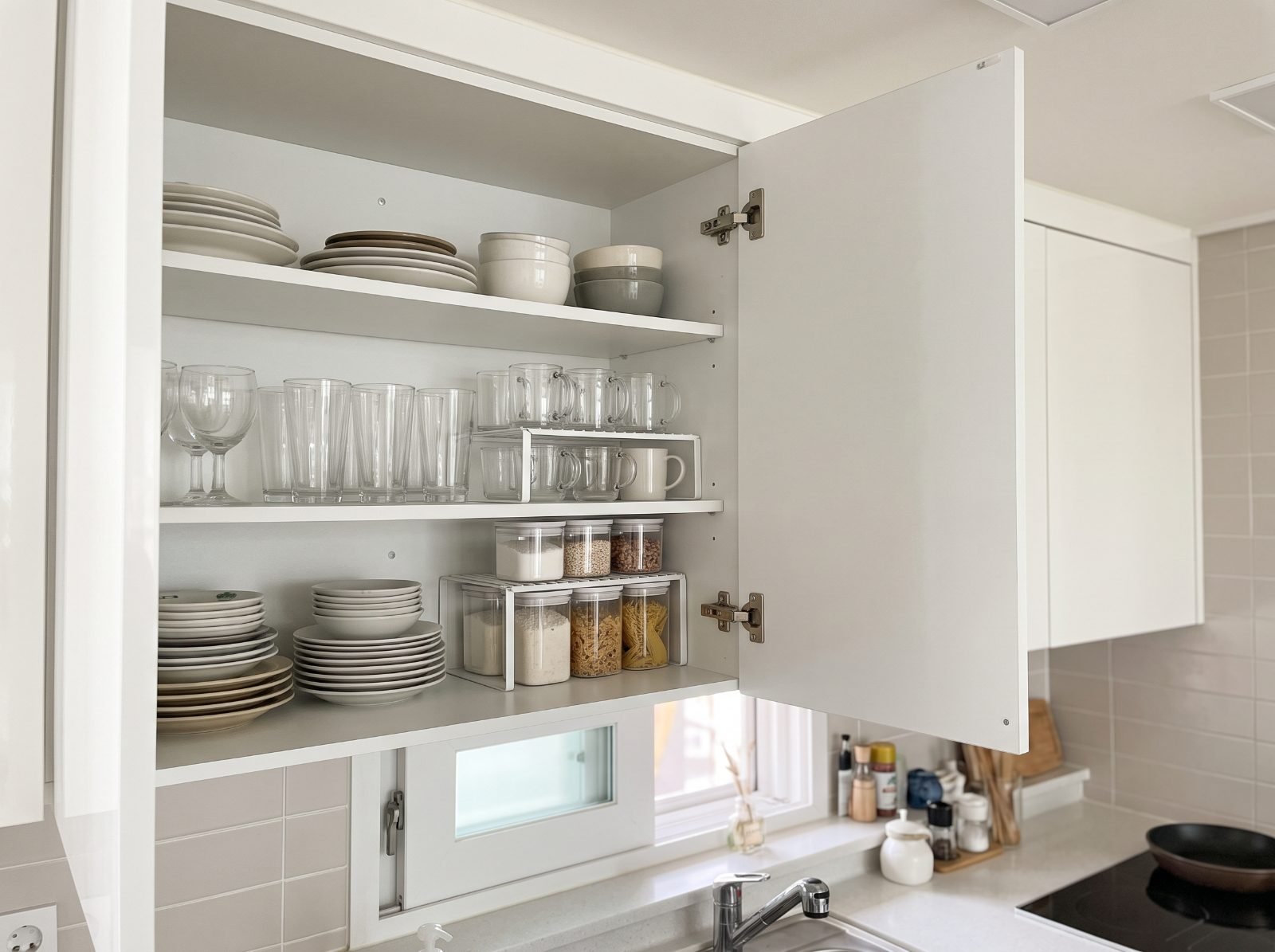
Most kitchen cabinets get organized once, the day you move in, and then slowly fill in whatever order things were unpacked. If you are wondering how to organize kitchen cabinets so they stay that way, the answer is to arrange them around what you do in each part of the kitchen. You will walk less, reach less and put things back more easily.
Step 1: Empty one cabinet at a time
Doing the whole kitchen at once turns into a counter covered with dishes. Start with the cabinet that bothers you most, empty it, wipe it, and sort items into keep, move to another zone, and donate. Then repeat.
Step 2: Assign zones
| Zone | Location | What goes there |
|---|---|---|
| Cooking | Next to and under the stove | Pots, pans, lids, oils, spices, spatulas |
| Prep | Near the largest counter space | Cutting boards, mixing bowls, measuring cups, knives |
| Cleaning | Under and near the sink | Dish soap, sponges, towels, trash bags |
| Dishes | Near the dishwasher or drying rack | Plates, bowls, glasses, mugs |
| Food storage | Near the fridge | Containers, foil, wraps, bags |
Step 3: Upper versus lower cabinets
- Upper cabinets: lighter items you use daily, such as glasses, mugs and plates, on the lowest shelf you can reach easily. Rarely used items go on the top shelf.
- Lower cabinets: heavy items like pots, pans and small appliances, so you are not lifting them overhead.
- Deep base cabinets: pull-out bins or sliding organizers so the back row is not forgotten.
Step 4: Use the vertical space
Most cabinet shelves have several inches of empty air above the stack. A shelf riser creates a second level for plates or bowls, and stacking mugs or glasses only two high keeps them stable.
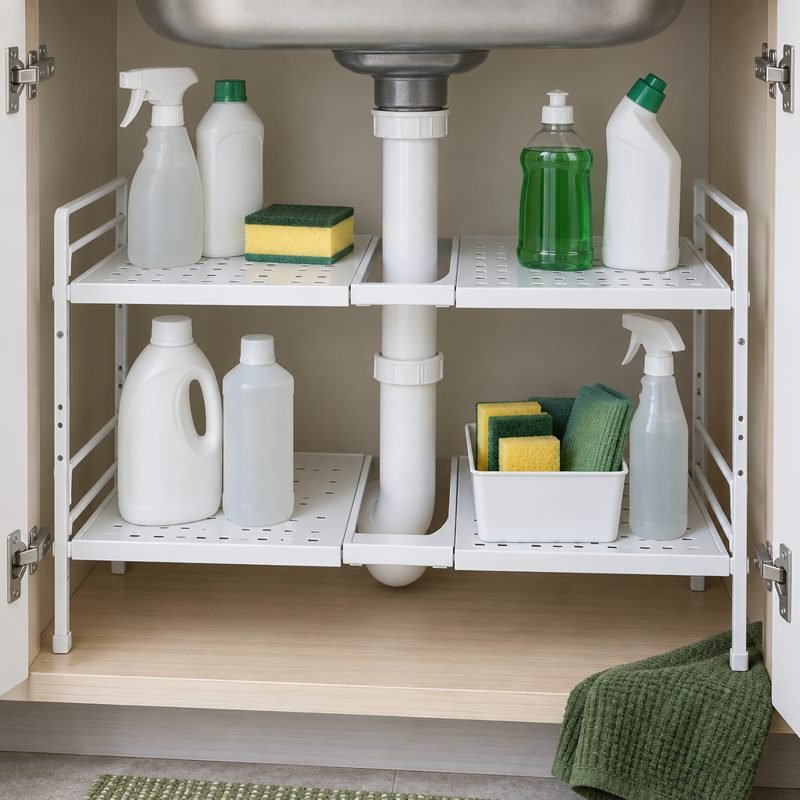
Widens to fit the cabinet, and the removable panels let the shelf sit around awkward pipes.
View on Amazon Add to Amazon cart 🛒Stand foil and wrap boxes up
Foil, plastic wrap, parchment and zip-top bag boxes usually end up stacked flat in a drawer, and the one you need is always at the bottom. A tiered rack inside a lower cabinet holds each box on its own shelf, so you can slide one out without moving the rest.
Check three things before you buy: the inside width of the cabinet (this rack expands from about 11 to 16.7 inches), the height of your longest boxes (set the tier heights first, because long boxes fit tight), and how much you load it. Several buyers said it flexes when pulled out to full width, so keep heavy items off the top tier.
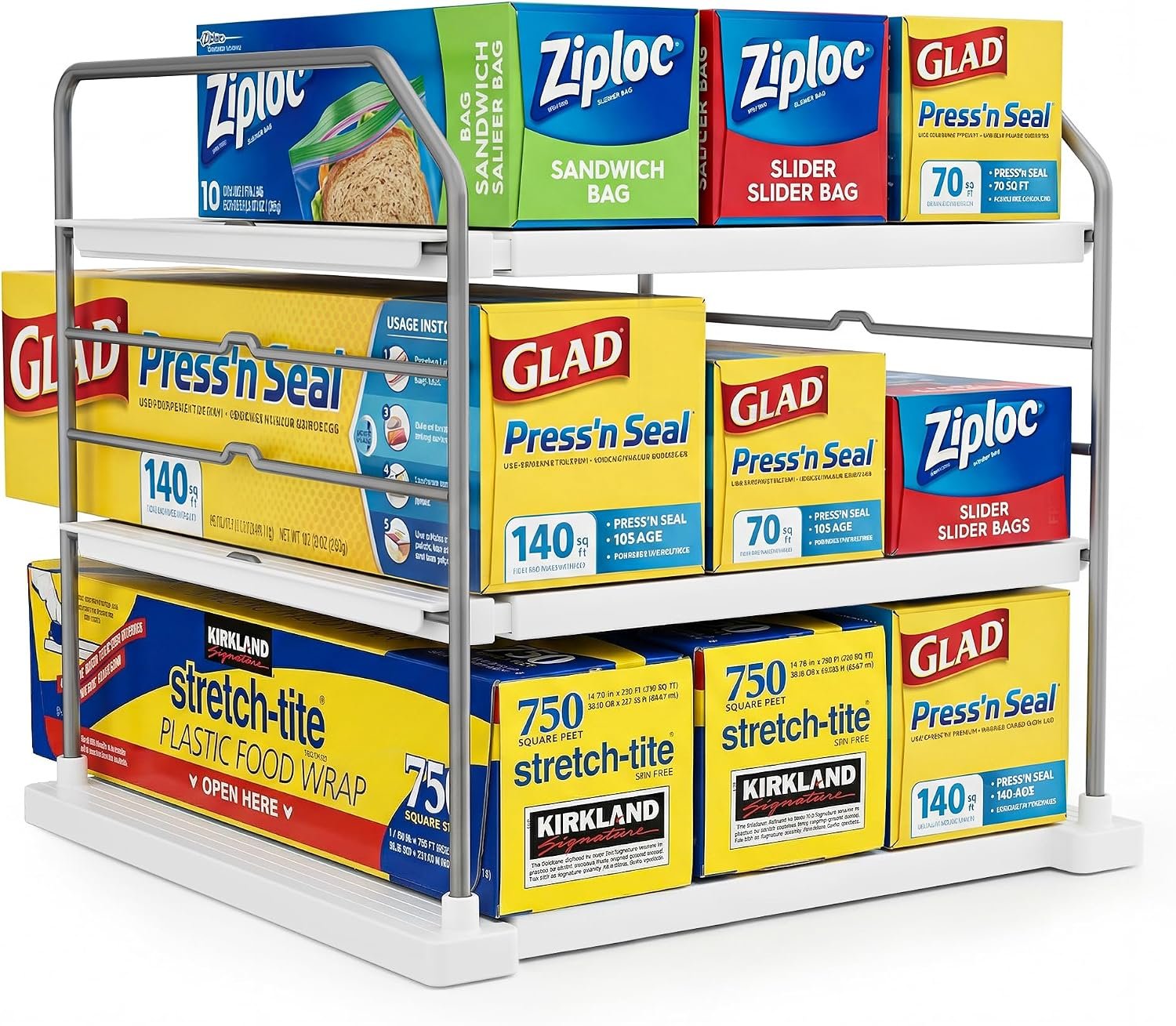
Expandable steel frame with three adjustable trays for foil, wrap and bag boxes. Tool-free setup.
View on AmazonAdd to Amazon cart 🛒Stand sheet pans and cutting boards upright
Sheet pans, muffin tins and cutting boards stacked flat mean lifting the whole pile to reach the bottom one. Standing them on edge in a slotted rack lets you pull out any single piece without moving the rest. Measure the cabinet height first: tall pans need clearance above the rack.
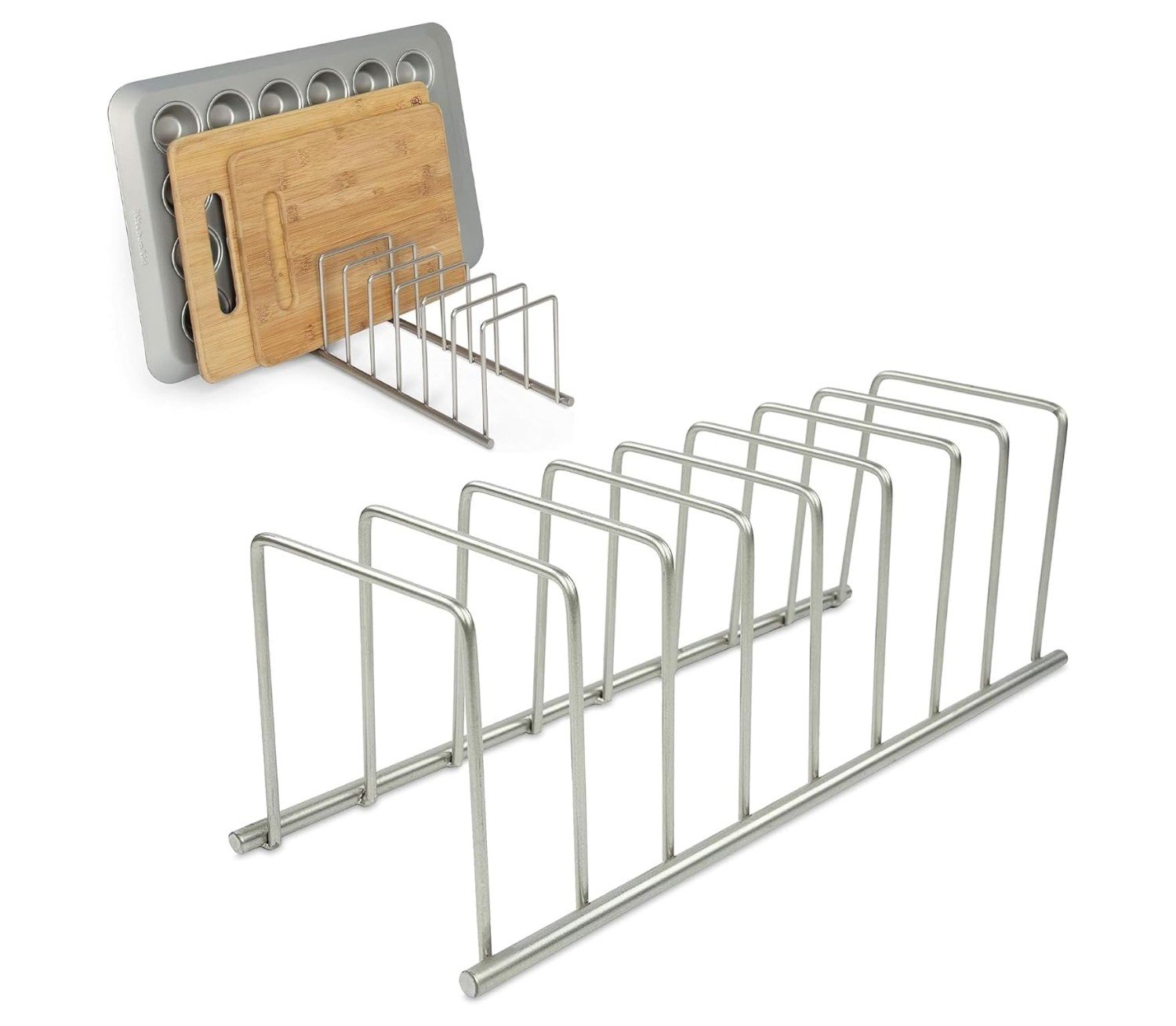
A satin-nickel steel rack with 8 upright slots, about 13.5" tall, 4.5" wide and 4.25" deep. Works inside a cabinet or on the counter.
View on AmazonAdd to Amazon cart 🛒Worth knowing before you buy: reviewers measured the slots at about 1 3/8", so thick roasting pans or deep dishes will not fit. A few received it with missing rubber end caps, which can scratch the cabinet floor, and some say the dividers bend under heavy cast pans.
Step 5: Fix the corner cabinet
Corner cabinets hide things because you cannot see the back. A turntable brings the back to the front with one turn, and it needs no installation.
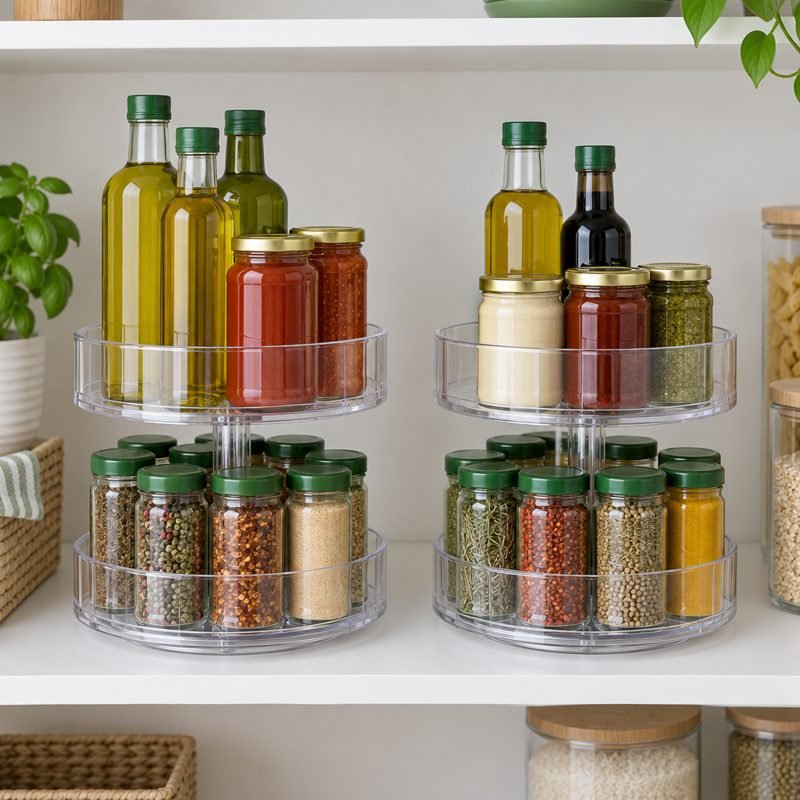
Spin to reach oils, sauces and spices at the back of a shelf. Two tiers use the height of the cabinet.
View on Amazon Add to Amazon cart 🛒Store pots and lids so they stay usable
- Nest pots by size and store lids upright in a rack or a bin next to them.
- Keep the pan you use daily on top, not at the bottom of the stack.
- Put a paper towel or pan protector between nonstick pans to avoid scratches.
In a deep base cabinet, the pot at the back is the one you stop using. A pull-out shelf screwed to the cabinet floor brings the back row out to you. Measure the opening between the hinges first: most need at least 15" of clear width.
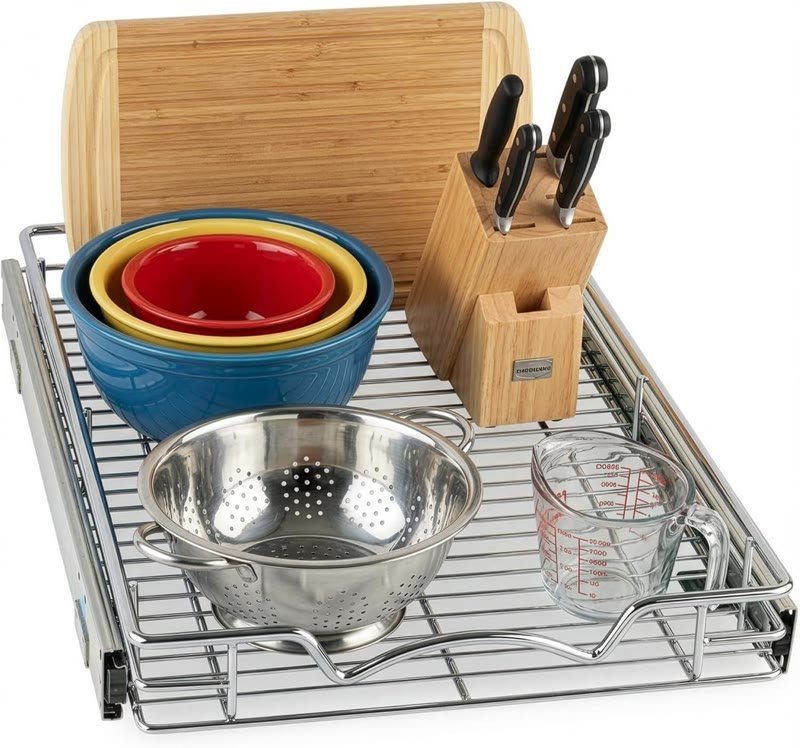
A chrome wire shelf on full-extension slides, rated for 50 lb; about 14" W x 21" D x 3.15" H and needs a cabinet opening of at least 15.25". Worth knowing: it comes in widths from 8" to 30", so measure your cabinet opening first; the included template with punch-out holes makes the screw spots easy to mark.
View on AmazonAdd to Amazon cart 🛒Plastic container lids are the part that usually collapses. Standing them on edge by size in a divided tray means you pull one lid without the rest sliding out. Measure the shelf height with your tallest lid standing in it before you buy.
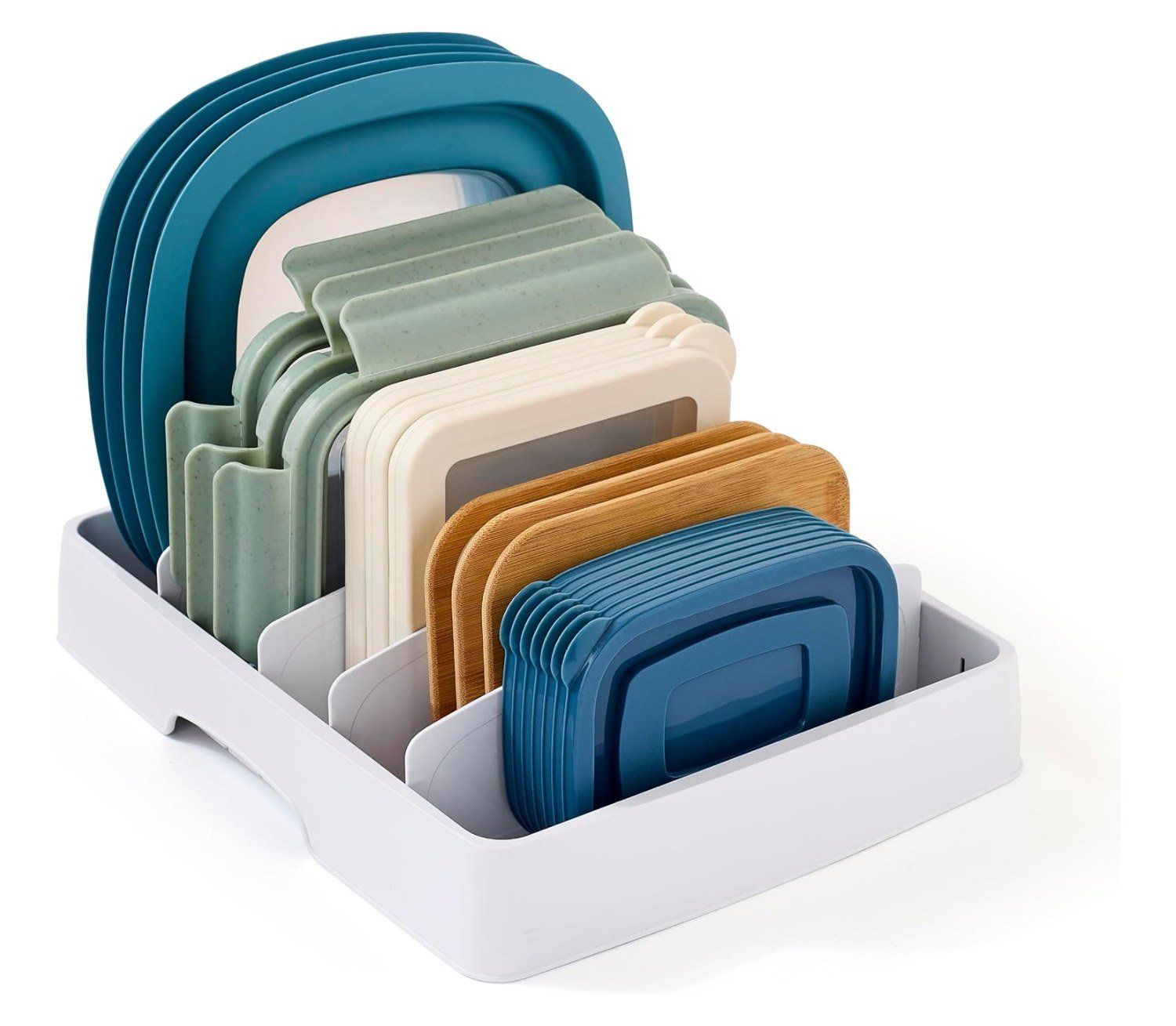
A tray with five adjustable dividers for lids up to about 9" wide; about 13.4" W x 10.5" D x 3.3" H, with handles to slide it out. Worth knowing: reviewers say the plastic is light and the dividers are short, so it suits plastic container lids, not heavy pot lids. Hand wash only.
View on AmazonAdd to Amazon cart 🛒Small kitchen adjustments
- Keep one set of everyday dishes in the easiest cabinet and store party serving pieces elsewhere, such as a closet shelf.
- Hang measuring cups or pot lids on the inside of a cabinet door with adhesive hooks.
- Use the top of the fridge for light, rarely used items in a bin.
- If cabinets are shallow, choose stackable bins that pull out like drawers.
Keep it working
Organized cabinets drift back to clutter when new items arrive without a plan. When you buy something new for the kitchen, decide which zone it belongs to before you put it away, and remove something you no longer use. A quick look through every cabinet twice a year, in spring and before the holidays, is enough to catch duplicates, chipped dishes and containers without lids.
How to organize kitchen cabinets: what goes where
Use this as a starting map, then adjust it to where your sink, stove and dishwasher actually are.
| Cabinet | Put here | Keep out |
|---|---|---|
| Upper, next to the dishwasher or sink | Everyday plates, bowls and glasses | Heavy serving pieces |
| Upper, next to the stove (not directly above it) | Spices, oils and cooking staples you reach for mid-recipe | Anything that softens or spoils with heat |
| Lower, beside the stove | Pots, pans and lids | Food storage |
| Lower, near the prep counter | Mixing bowls, cutting boards, baking sheets | Rarely used appliances |
| Under the sink | Cleaning supplies, trash bags, dish soap refills | Food and anything that must stay dry |
| Top shelf or above the fridge | Holiday platters, seasonal items, backups | Daily items |
| Corner cabinet | Items you use weekly, on a turntable or pull-out | Heavy daily pans |
A 30-minute version
- Pick the one cabinet that bothers you most and empty it.
- Put back only what belongs in that zone, using the table above.
- Move the leftovers to the cabinet where they will be used, or into a donate box.
- Add one helper where space is wasted: a shelf riser for stacked plates, an upright rack for sheet pans, or a turntable in a corner.
- Repeat with one more cabinet the next day.
Two spots usually need their own plan: the sink base (see under-sink organizers that fit around pipes, or bathroom under-sink storage around pipes for the vanity) and a narrow pantry door (see pantry door organizers for narrow doors).
Frequently asked questions
How do I organize a kitchen with very few cabinets?
Use the walls, the inside of cabinet doors and the top of the fridge for light items, and keep only one set of everyday dishes in the cabinets.
Should I line my cabinet shelves?
A wipe-clean liner protects shelves from spills and scratches, especially under the sink and near the stove.
How often should I reorganize?
A quick check twice a year is enough for most kitchens. Move things you have stopped using to a higher shelf or donate them.
What goes in upper versus lower kitchen cabinets?
Upper cabinets suit light, everyday items like plates, glasses and spices. Lower cabinets suit heavy items like pots, pans and mixing bowls, so you never lift them overhead.
What is the easiest way to organize deep base cabinets?
Bring things to the front with pull-out drawers or bins you can slide out, and store items upright instead of in tall stacks.