How to Tell If Turkey Is Done (Without Cutting It Open)
The timer says it should be ready, the skin looks perfect, and someone reaches for a knife to cut into the thigh "just to check." There is a cleaner way to know, and it does not leave a gash in the bird.
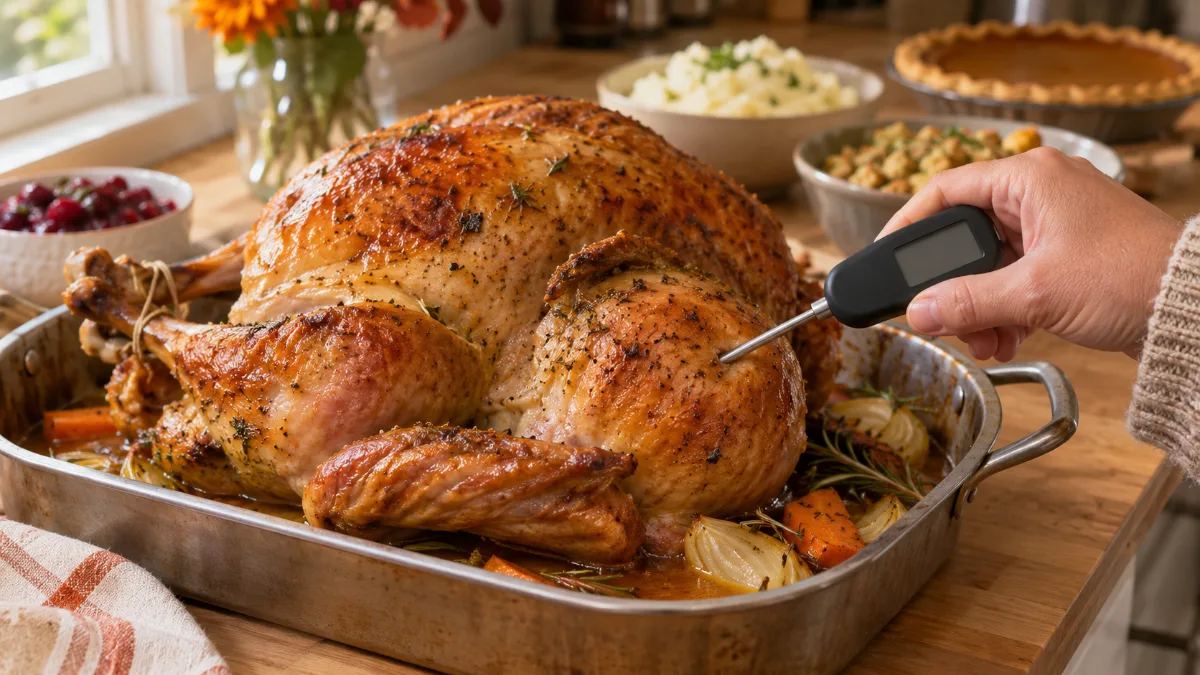
If you want to know how to tell if turkey is done, the short answer from USDA is simple: a whole turkey is safe once a food thermometer reads at least 165°F in three places, the innermost part of the thigh, the innermost part of the wing, and the thickest part of the breast. Cutting it open, checking juice color or trusting the cooking chart only gives you hints. A thermometer gives you the number.
Why cutting it open or eyeballing it does not work well
Most "is it done?" tricks look at the outside or at one spot. A turkey is big and uneven: the breast is thick, the thighs are dense dark meat close to the bone, and the cavity slows heat. One part can be ready while another is still under temperature. That is why USDA asks for three readings, not one.
| Common check | What it tells you | Problem |
|---|---|---|
| Cutting into the thigh | Color of the meat at one spot | Color is not a temperature; you also lose juices and a clean carve |
| Clear juices | A rough hint | Not a USDA doneness test |
| Leg wiggles loosely | Dark meat is getting tender | Says nothing about the breast or wing |
| Pop-up timer popped | One spot got hot | USDA still recommends a thermometer check in three places |
| Cooking time chart | A planning estimate | USDA calls its times approximate; ovens and birds vary |
| Food thermometer | The actual internal temperature | Needs to be placed correctly (see below) |
How to check turkey doneness in 5 steps
You do not need a special gadget for this, only a food thermometer you already trust. Any instant-read or dial food thermometer works if you place it correctly.
- Start checking before the chart says it is done. USDA roasting times (at 325°F) are approximate, so begin checking a little early.
- Thigh first. Insert the probe into the innermost part of the thigh, near where it joins the body, aiming toward the thigh and not touching bone. Dark meat usually takes longest, so this is the reading most likely to be low. CDC describes this spot as where the body and thigh join.
- Then the wing. Check the innermost part of the wing, where it joins the body, again avoiding bone.
- Then the thickest part of the breast. Go in from the side toward the center of the thickest part, not just under the skin.
- All three at 165°F or higher? It is done. If any reading is below 165°F, put it back in and check again in a while. Stuffed bird? The center of the stuffing must reach 165°F too.
Then let it rest 20 minutes
USDA says to let the turkey stand for 20 minutes before carving so the juices set and the bird carves more easily. If you stuffed it, CDC and USDA say to let it stand those 20 minutes before removing the stuffing. Leftovers should go in the fridge within two hours of coming out of the oven.
Watch the short
This short shows the cut-it-open habit and the thermometer check that replaces it. Some scenes were made with AI.
One tool option: an instant-read thermometer with a backlight
If you do not own a food thermometer, or yours is slow and hard to read in a dim oven, an instant-read model makes the three-spot check quick. The one in the video is the Alpha Grillers digital meat thermometer (#ad). Its listing describes a large display with a blue backlight, an IP67 waterproof rating so it can be rinsed under running water, and a spare battery in the box. It has a 4.8-star average from more than 3,000 ratings on that listing.
The honest catch: some buyers mention that the backlight switches off quickly, so you may need to wake it again between readings. Check today's price on Amazon.
Common mistakes
- Touching bone with the probe. Bone conducts heat differently and can throw off the reading.
- Checking only the breast. The thigh is usually the slowest spot.
- Reading too shallow. A probe sitting just under the skin reads hot skin, not the center.
- Trusting the pop-up alone. Use it as a hint, then confirm in three places.
- Carving right away. Give it the 20-minute stand first.
Frequently asked questions
What temperature is turkey done?
USDA says a whole turkey is safe once it reaches a minimum internal temperature of 165°F, measured with a food thermometer in the innermost part of the thigh and wing and the thickest part of the breast. You can cook it hotter for texture, but 165°F is the safety line.
Can you tell if turkey is done without a thermometer?
Not reliably. Clear juices, wiggly legs and golden skin are common hints, but USDA guidance is to confirm doneness with a food thermometer. Color alone does not tell you the temperature inside.
Is the pop-up timer enough?
USDA calls pop-up timers a useful tool but still recommends checking the thigh, wing and breast with a food thermometer, because the timer only reads one spot.
How long should turkey rest before carving?
USDA and CDC both say to let the turkey stand about 20 minutes before carving (and before removing any stuffing). The juices set and the bird carves more easily.
Sources
- USDA FSIS: Let's Talk Turkey, a consumer guide to safely roasting a turkey
- USDA FSIS: Turkey Basics, safe cooking
- USDA FSIS: Turkey Day myths (pop-up timers)
- CDC: Preparing your holiday turkey safely
Checked November 12, 2026. Product details are from the Amazon listing and its customer reviews; we have not tested this thermometer ourselves.