How to Make a Smoothie Without Making a Mess (Splatter and Leak Fixes)
The blender roars, the lid lifts a quarter inch, and pink drops land on the backsplash, the cabinets and your shirt. Or a slow drip shows up under the base. Smoothie messes have a short list of causes, and most of them are fixed with the blender you already own.
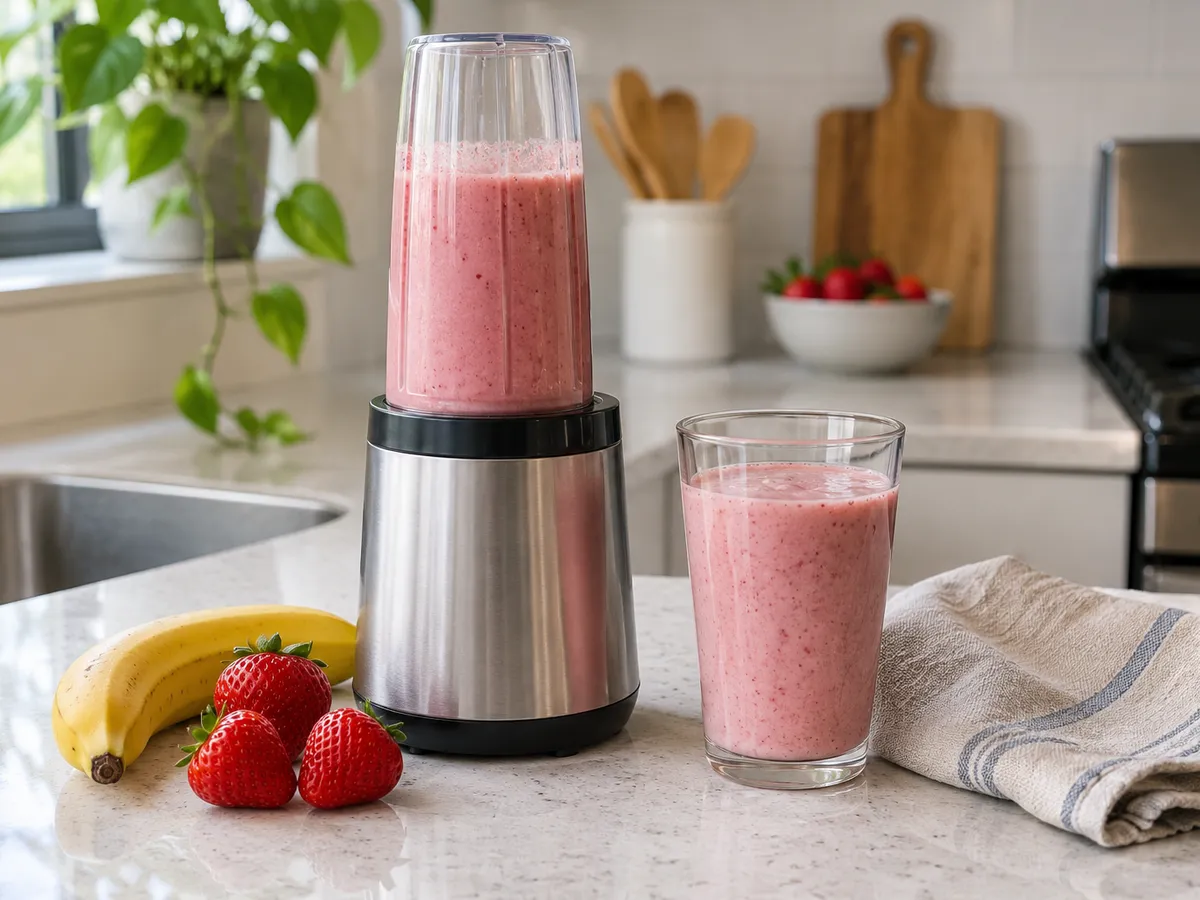
If you want to know how to make a smoothie without making a mess, look at where the mess comes from. Splatter out of the top means the lid, the fill level or the start-up speed. A puddle under the jar means the seal at the bottom. A spray when you open the lid or pour usually means you moved too soon. Each one has a simple fix.
Blender makers repeat the same basics in their manuals: keep the lid in place while the motor runs, do not fill past the MAX line, and do not blend hot ingredients in a sealed container. Below, the causes are laid out first, then the fixes that cost nothing, and then one tool option for people who blend a single drink most mornings.
Why smoothies splatter and leak
| Cause | What you see | Fix |
|---|---|---|
| Lid not fully seated | Lid lifts and sprays as the blender starts | Press the lid down until it seals before you turn it on |
| Filled past the MAX line | Smoothie climbs up and pushes out the top | Stay under the line; blend in two batches |
| Starting on high with a heavy load | A sudden surge up the sides of the jar | Start low or pulse, then raise the speed |
| Gasket missing, twisted or blade base loose | Drips or a puddle under the jar | Reseat the gasket and screw the base on straight and snug |
| Warm or hot ingredients | Lid pushed up by steam pressure | Let ingredients cool; follow your manual |
| Lifting the jar while the blade still spins | A ring of spray across the counter | Wait for the blade to stop completely |
6 fixes with the blender you have
- Seat the lid every time. Hamilton Beach's use and care guides say to always operate the blender with the lid in place. Press it down until it feels snug all the way around, and if your lid has a center cap, make sure the cap is in too. For a cold smoothie, a hand resting on the lid as the motor starts keeps it from lifting.
- Respect the MAX line. Ninja's Fit blender guide says not to go past the MAX LIQUID line, and NutriBullet's guide says not to overfill the pitcher beyond the MAX line. A smoothie needs room to move as it blends. If your recipe does not fit, blend half, pour it out and blend the rest.
- Load in a sensible order. Ninja's quick start guide lists fresh fruit and vegetables first, then leafy greens, then liquid or yogurt, then powders and nut butters, with ice and frozen ingredients last. Cutting ingredients into about 1-inch pieces, as the same guide suggests, also means fewer big chunks bouncing against the lid.
- Start slow, then speed up. NutriBullet's guide says to start on the LOW setting when using manual speeds. A few short pulses break up frozen fruit before the full-speed run, so the blend does not lurch up the jar all at once.
- Check the gasket and the blade base. If the drip is at the bottom, take the jar apart and look at the rubber ring. Blender troubleshooting guides point to a missing or misplaced gasket and a misaligned locking collar as the usual reasons a jar leaks at the base. Wash it, set it flat in its groove and screw the blade base on straight. A cracked gasket or jar needs a replacement part from the maker.
- Wait for the blade to stop. Blender manuals commonly warn against removing the jar before the motor has stopped. Lifting early throws smoothie off the spinning blade. Let it stop, lift, then open the lid slowly over the sink if the jar is very full.
A towel under the base and a quick wipe of the threads before you pour also keep drips off the counter, and they cost nothing.
A note on hot ingredients
Warm ingredients are the one mess that can also burn. Breville and the Ninja Fit guide say not to blend hot ingredients in those containers, and Hamilton Beach notes that hot liquid can be ejected from the jar by sudden steaming and that hot liquids may push the lid off. Its manuals allow warm blending only with the filler cap removed, a reduced fill level, and an oven mitt or thick towel held over the lid. If you make smoothies with freshly brewed coffee or tea, chill it first, as Ninja's mocha shake recipe does.
Watch the fix in 15 seconds
This short shows a smoothie ending up all over the counter and a switch to blending in a sealed single-serve cup. Some scenes were made with AI.
If you blend one drink most mornings
If your smoothie is usually a single serving, a personal blender removes the loose lid from the picture. You fill the cup, screw the blade assembly onto it, flip it upside down onto the base and press down to blend; afterwards you twist the blades off and put a spout lid on the same cup. The one in the video is the Ninja Fit Compact Personal Blender (#ad). Its listing describes a 700-watt push-to-blend motor base, two 16-ounce single-serve cups with two spout lids, BPA-free parts and top-rack dishwasher-safe cleanup, and it takes little counter space in a small kitchen. It has a 4.7-star average from more than 42,000 ratings.
The honest catch, from buyer reviews: it is small, and several 3-star reviewers say 16 ounces is less than they expected. Some find the tall cups hard to clean by hand, some say thick frozen loads need a shake and another blend, one reviewer says it got hot and shut off after two smoothies in a row, and some mention noise. The blade assembly still has to be screwed on tight, and Ninja says to stay under the MAX LIQUID line and not to blend hot ingredients. Check today's price on Amazon.
Common mistakes
- Topping the jar up to the rim. Overfilling is the fastest route to a lid that pops.
- Hitting the highest speed first. Start low or pulse and let the blend settle into a vortex.
- Ignoring a small drip at the base. It is almost always the gasket or a crooked blade base, and it gets worse.
- Blending fresh hot coffee or tea. Cool it first, or follow your manual's hot-blending steps exactly.
- Pulling the jar off mid-spin. Wait for the blade to stop before lifting or opening.
Frequently asked questions
Why does my blender leak from the bottom?
Leaks at the base usually come from the seal between the jar and the blade assembly. Check that the rubber gasket is in place and not twisted, and that the blade assembly or locking ring is screwed on straight and snug. Blender troubleshooting guides list both as the first things to check.
Is it safe to hold the blender lid down while it runs?
For cold smoothies, keeping a hand on a seated lid is fine and stops it lifting. For anything warm, follow your blender's manual: several manufacturers say not to blend hot liquids at all, and those that allow it ask for a towel or oven mitt over the lid and a reduced fill level.
What order should smoothie ingredients go in?
Ninja's Fit blender quick start guide lists fresh fruit and vegetables first, then leafy greens, then liquid or yogurt, then powders and nut butters, and ice or frozen ingredients last. Other blenders differ, so check your own manual.
Can I blend warm soup in a personal blender?
Not in the one covered here. Ninja's Fit quick start guide says not to blend hot ingredients. Single-serve cups seal tightly, so heat and steam have nowhere to go.
Sources
- Ninja Fit Blender Quick Start Guide (QB3000SS series, PDF on the Amazon listing)
- Hamilton Beach Blender 53520 Use and Care
- Breville the Super Q instruction booklet
- NutriBullet Power Core blender user guide
- Household blender instruction manual, troubleshooting section
Checked November 9, 2026. Product details are from the Amazon listing and its customer reviews; we have not tested this blender ourselves.