How to Measure Flour Without a Mess (and Get the Right Amount)
Flour on the counter, a stack of floury cups in the sink and cookies that still come out dry. The fix is the same for all three: stop packing flour into cups.
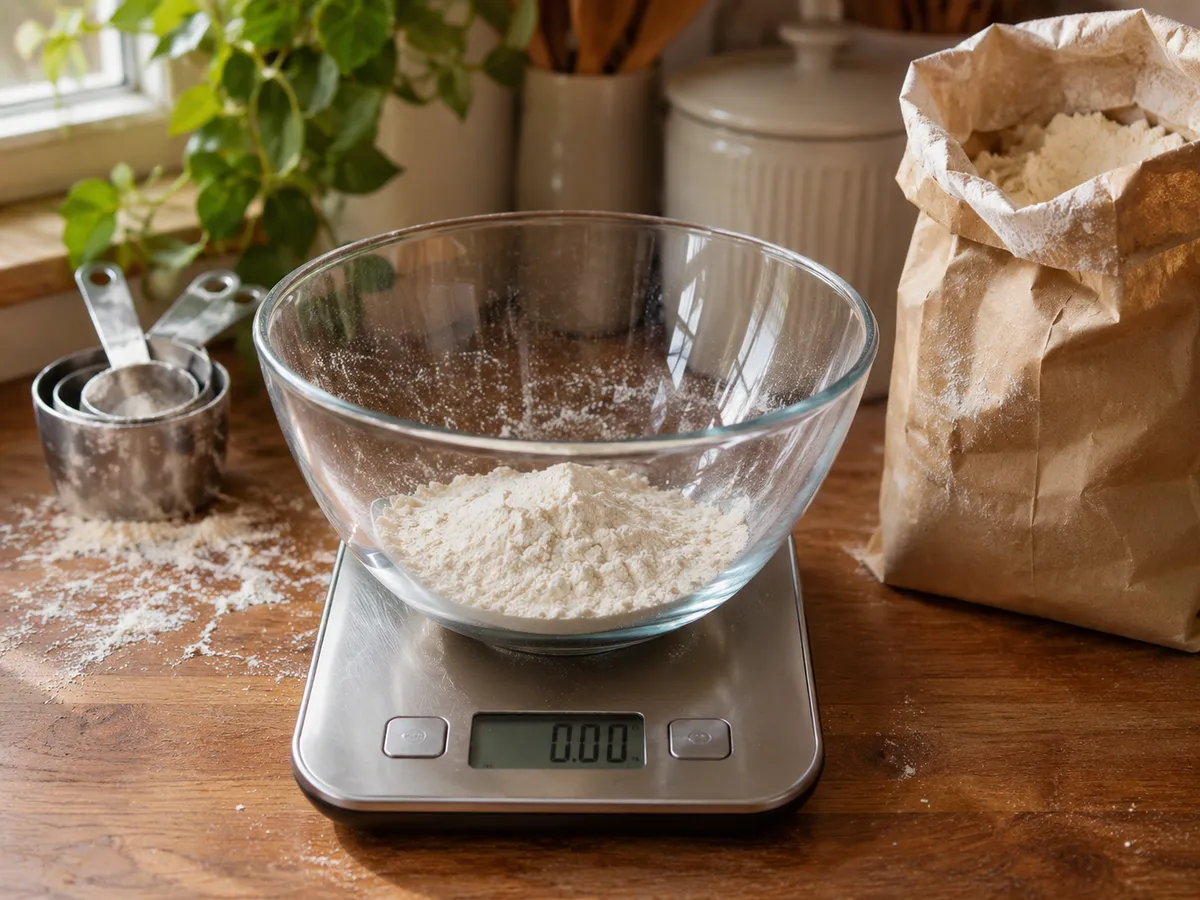
If you want to know how to measure flour without a mess, start with the reason the mess happens. Most of it comes from scooping: the cup goes into the bag, comes out heaped, gets tapped or pressed, and the extra is scraped off over the counter. Scooping also packs the flour, so the cup holds more than the recipe expects. One habit causes both problems.
King Arthur Baking says a cup of all-purpose flour that is fluffed, spooned and leveled weighs about 120 grams, while a packed cup can hold up to 160 grams. America's Test Kitchen found up to a 20 percent difference between cups measured by different people. That gap is enough to turn soft cookies into dry ones.
Below are two ways to fix it: a no-tools method that keeps flour off the counter, and the faster scale method that skips measuring cups entirely.
Why measuring flour gets messy
- The cup goes into the bag. A heaped cup drags flour over the rim, and the bag's narrow opening catches more of it.
- Leveling happens over the counter. The excess falls wherever the cup is held, usually next to the bowl.
- Tapping and pressing. Tapping the cup to "settle" it packs the flour and throws dust into the air.
- Several cup sizes. A recipe that needs 2 3/4 cups means three cups, three rounds of leveling and three floury cups to wash.
Method 1: spoon and level, without the mess
This works with the measuring cups you already own. The trick is to do every step over something that catches the extra.
- Move flour to a wide container. A wide-mouth canister or bin gives the spoon room and keeps the bag from tipping. If you keep the bag, roll the top down so the opening is wide.
- Fluff it. Stir the flour with a spoon or whisk so it is not packed from sitting.
- Hold the cup over the container. Not over the counter. Spoon flour into the cup until it is heaped above the rim. Do not tap or shake the cup.
- Level back into the container. Sweep the straight back of a knife across the rim so the extra falls back where it came from.
- Pour into the mixing bowl, close to the rim. Lower the cup into the bowl before tipping it so the flour does not puff out.
If you only have one counter spot, lay a sheet of parchment under the container. Afterward, fold it into a funnel and pour any spill back in.
Method 2: weigh it straight into the bowl
Weighing is faster and cleaner because there is nothing to level and nothing to wash except the bowl you were going to use anyway. King Arthur and America's Test Kitchen both recommend weighing when a recipe gives grams.
- Turn on the scale and set your mixing bowl on it.
- Press the tare (zero) button so the display reads 0.
- Spoon or pour flour slowly into the bowl until you reach the weight in the recipe. For a recipe in cups only, use about 120 grams per cup of all-purpose flour, the figure King Arthur uses.
- Press tare again and add the next dry ingredient on top. One bowl, no cups.
Pour low and slowly near the target. Flour that overshoots is easy to spoon back out because it is sitting on top.
| Recipe says | All-purpose flour by weight |
|---|---|
| 1/4 cup | 30 g |
| 1/3 cup | 40 g |
| 1/2 cup | 60 g |
| 1 cup | 120 g |
| 2 cups | 240 g |
| 3 cups | 360 g |
Based on 120 g per cup (King Arthur Baking). Other flours weigh differently; when a recipe lists grams, use the recipe's number.
See the difference in 15 seconds
This short shows the cup-and-knife mess next to the weigh-into-the-bowl method. Some scenes were made with AI.
If you want a scale for this
Any digital kitchen scale with a tare button and 1-gram steps does the job. The one in the video is the Etekcity food kitchen scale (#ad). Its listing describes a flat stainless platform, an 11 lb (5 kg) capacity, 1 g increments, a tare button and five units, and it is thin enough to store in a cabinet, which matters in a small kitchen. The honest catch: most ratings are positive, but some buyers report readings that are off out of the box or drift over time. Check it against a recipe you know well in the first weeks, and replace the batteries before deciding it is inaccurate. Check today's price on Amazon.
Common mistakes
- Using a liquid measuring cup for flour. You cannot level it, so the amount varies.
- Sifting when the recipe does not say so. "1 cup sifted flour" (sift, then measure) and "1 cup flour, sifted" (measure, then sift) are different amounts.
- Forgetting to tare. If the bowl's weight is counted, the recipe gets far too little flour.
- Wiping spilled flour with a wet cloth first. Water turns it into paste. Sweep or dry-wipe first, then wipe with a damp cloth.
- Tasting raw dough. FDA notes that flour is a raw food and advises against eating raw flour, dough or batter. Wash hands and surfaces after handling it.
Frequently asked questions
Should I scoop flour with the measuring cup?
No. Scooping packs the flour, so the cup holds more than the recipe intends. Spoon flour into the cup and level it, or weigh it.
How many grams is a cup of flour?
King Arthur Baking uses 120 grams for a cup of all-purpose flour. Other sources use 125 to 130 grams. If a recipe gives grams, follow the recipe's own number.
Is a kitchen scale worth it in a small kitchen?
A flat scale takes less space than a full set of measuring cups and spoons for dry ingredients, and it removes most of the washing. If you bake only a few times a year, the spoon-and-level method above works fine.
How do I keep flour from puffing out of the bowl?
Pour from low, close to the bowl's rim, and add flour in small amounts near the target weight. A deeper bowl also helps.
Sources
- King Arthur Baking: How to measure flour the right way
- King Arthur Baking: Ingredient Weight Chart
- America's Test Kitchen: Measuring Flour
- FDA: Flour Is a Raw Food and Other Safety Facts
Checked November 5, 2026. Product details are from the Amazon listing and its customer reviews; we have not tested this scale ourselves.