How to Keep Ramen From Boiling Over (Stove and Microwave Fixes)
You turn away for thirty seconds and the pot is foaming over the rim, hissing on the burner. Or the microwave turntable is swimming in salty water. Ramen boil-over has a few clear causes, and most of them are fixed with the pot and bowl you already own.
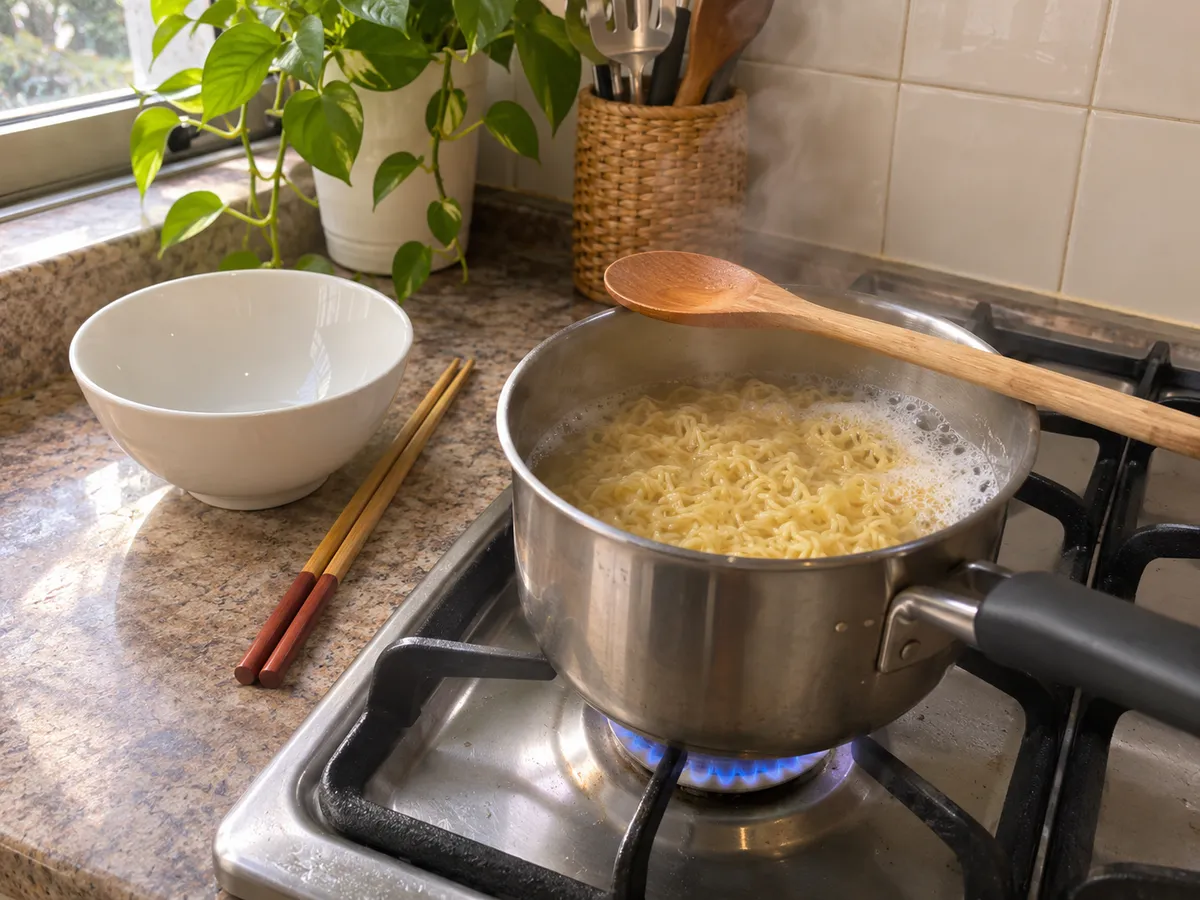
If you want to know how to keep ramen from boiling over, start with the foam. As the dried noodle block softens, it releases starch into the water. Starchy water holds bubbles together instead of letting them pop, so they stack up into foam. Add a small pot, high heat and a lid, and that foam has nowhere to go but over the edge.
The standard package directions are simple. Maruchan's ramen noodle soup packs say to boil 2 cups of water in a saucepan, add the noodles and cook 3 minutes, stirring occasionally, then turn off the heat before adding the seasoning. Problems start when the pot is too small for those 2 cups, the burner stays on high after the noodles go in, or the water is eyeballed.
Below are fixes for the stove and for the microwave, in the order to try them. None of them needs a new gadget.
Why ramen boils over
| Cause | What you see | Fix |
|---|---|---|
| Starch from the noodles | Thick white foam right after the block goes in | Stir occasionally, skim the foam, lower the heat |
| Pot or bowl too small | Foam reaches the rim within a minute | Leave a few inches of headroom above the water |
| Heat left on high | Rolling boil that keeps climbing | Turn down to a steady simmer once it returns to a boil |
| Tight lid or cover | Foam squeezing out under the lid | Cook with the lid off, or tilted open |
| Too much water | Watery broth and a fuller pot | Measure the amount on the package |
Stovetop: 5 fixes with the pot you have
- Measure the water. Use a measuring cup for the amount printed on your package, which is 2 cups for a standard Maruchan pack. Extra water raises the level, thins the broth and leaves less room for foam.
- Pick a pot with headroom. Two cups of water fill a tiny saucepan more than you think. A pot where the water sits well below halfway gives rising foam room to settle before it reaches the rim.
- Bring the water to a boil first, then turn it down. Add the noodles once the water boils, and when it comes back to a boil, lower the burner until it simmers steadily. Ramen cooks fine at a lively simmer; a hard rolling boil mostly makes foam.
- Leave the lid off. A lid traps steam under the foam and pushes it out at the edge. If you want to keep the heat in while the water comes to a boil, take the lid off before the noodles go in.
- Stir and skim. The package says to stir occasionally. Stirring breaks up the bubble layer, and a spoon can lift off excess foam. Laying a wooden spoon across the top is a common backup trick, but it only buys a little time; lowering the heat is the real fix.
Turn off the burner before you add the seasoning packet, as the package directs, so the pot is no longer boiling while you stir it in.
Microwave: 4 fixes for bowls and cups
- Follow the line and the time on the package. Maruchan's instant ramen bowls say to fill the container to the inside line with room temperature water, remove the lid completely and microwave uncovered for 3 minutes on high in a 1000 watt oven, then leave it in the microwave for 1 minute. The package notes that time varies with altitude and microwave wattage.
- Know your microwave's wattage. A lower-wattage oven needs longer, a stronger one boils sooner. USDA FSIS describes a simple time-to-boil test with one cup of ice-cold water to estimate wattage if the label is missing.
- Use a deep, microwave-safe bowl. For a noodle block in a regular bowl, choose one tall enough that the water sits well below the rim, and do not seal it with plastic wrap or a tight lid.
- Let it stand before you grab it. Water heated in a microwave can become superheated: hotter than its boiling point without bubbling. The FDA and USDA both warn that a small disturbance, such as picking up the container or dropping something into it, can make it erupt. Wait, then lift it out carefully with a dry towel or mitt.
Watch the fix in 15 seconds
This short shows ramen foaming over and the switch to a microwave ramen cooker. Some scenes were made with AI.
If you make ramen often
If you cook instant ramen a few times a week and want to skip the pot, a container shaped for one noodle block is the tool option. The one in the video is the Rapid Ramen Cooker 2-pack (#ad). Its listing describes rectangular polypropylene bowls sized for a standard ramen block, a fill line for the water, about 3 minutes in the microwave, BPA-free material and dishwasher-safe cleanup. It has no lid, and the bowls replace a saucepan for this one job, which helps in a small kitchen. It has a 4.7-star average from more than 6,000 ratings. The honest catch, from buyer reviews: it is small and fits one pack at a time, some buyers find the fill line leaves too little broth for their taste and add a bit more water, and cooking time still depends on your microwave, so a few people settle between 3 and 4 minutes. It still needs care with hot water when you take it out. Check today's price on Amazon.
Common mistakes
- Leaving the burner on high the whole time. The noodles cook at a simmer; high heat only builds foam.
- Covering the pot to make it faster. The lid traps steam and forces foam out the side.
- Eyeballing the water. More water means a fuller pot and a weaker broth.
- Sealing a microwave bowl with plastic wrap. Pressure builds and foam escapes under the edge.
- Grabbing the bowl the second the microwave stops. Let it stand first and use a towel; the bowl and water are very hot.
Frequently asked questions
Why does ramen foam so much more than plain water?
The dried noodle block releases starch into the water as it softens. Starchy water holds bubbles together instead of letting them pop, so the foam stacks up and climbs the sides of the pot or bowl.
Does a wooden spoon across the pot really stop boil-over?
It is a common kitchen trick that can knock down rising bubbles for a short time, but it does not replace turning the heat down. Treat it as a backup, not the fix.
Should I cover ramen in the microwave?
Follow the package. Maruchan's instant bowl directions say to remove the lid completely and microwave uncovered. A tight cover traps steam and pushes foam out at the edges.
Why did my microwave ramen water suddenly erupt?
Water heated in a microwave can become superheated, hotter than its normal boiling point without visibly boiling. The FDA and USDA both warn that a small disturbance, such as moving the container, can make it boil violently. Let it stand before removing it and handle it carefully.
Sources
- Maruchan Ramen Noodle Soup package directions (as listed by Safeway)
- Maruchan Ramen Noodle Soup Bowl microwave directions (as listed by GIANT Food Stores)
- USDA FSIS: Cooking with Microwave Ovens
- FDA: Microwave Ovens
Checked November 8, 2026. Product details are from the Amazon listing and its customer reviews; we have not tested this ramen cooker ourselves.